
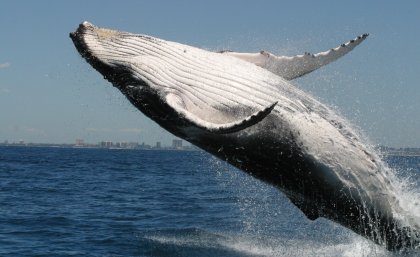
Humpback whale filmed off Peregian Beach on Queensland’s Sunshine Coast, the primary field site for UQ’s Cetacean Ecology and Acoustics Laboratory (CEAL). Credit: CEAL.
Humpback whales learn songs in segments – like the verses of a human song – and can remix them, a new study involving University of Queensland research has found.
The study featured data from Associate Professor Michael Noad of the UQ School of Veterinary Science’s Cetacean Ecology and Acoustics Laboratory (CEAL).
Research indicated that whale songs appeared to be learnt a similar way to how humans acquire language skills, or a bird learns its warble.
“All the males in a population sing the same complex song, but the pattern of song changes with time, sometimes quite rapidly, across the population,” Dr Noad said.
“Learning new songs is a form of what's known as 'social learning', which is where individual animals learn behaviours from each other rather than having them passed on from one generation to another genetically.
“Although we know that whales change their songs over time, we don't know about how they learn the new songs.
“The rate of change though shows that they are constantly learning and updating their songs rapidly.”
The study was led by UQ graduate Dr Ellen Garland, now a postdoctoral fellow at the University of St Andrews, Scotland, and focused on whale songs that were in the process of changing from one type to another.
The research found whales could combine segments of songs in predictable ways if the underlying structural pattern was similar.
“We recorded many individual singers from several populations, including the eastern Australian population and other populations in the South Pacific,” Dr Noad said.
“We looked for songs that were caught in the act of changing; songs that had some of the old song as well as some of the new song.
“Ellen found a couple of interesting things. When we found these rare 'hybrid' songs, the themes of the songs, either old or new, were intact, showing that the whales probably learn songs theme-by-theme like the verse of a human song.
“The other interesting thing was when they switched mid-song from old to new or new to old, it was during a theme most similar to another theme in either old or new songs.
“These themes may have been used as a way of bridging the old and new songs and therefore help with social learning.
“This provides some evidence for how animals rapidly learn large, complex displays and may have relevance for understanding how human language, the most outstanding example of social learning, evolved.”
Dr Noad said changes in humpback whale songs were one of the most striking examples of the transmission of a cultural trait and social learning in any non-human animal.
The study, Cultural transmission in humpback whales: insights from song hybridization events during revolutionary song change, is published in the Proceedings of the National Academy of Sciences (PNAS) journal (doi/10.1073/pnas.1621072114).
Media: Associate Professor Michael Noad, mnoad@uq.edu.au, +61 7 54 601876; Dr Ellen Garland, ecg5@st-andrews.ac.uk, +44-7478-649964. UQ Communications, communications@uq.edu.au, +61 7 3365 3439.


