
The incidence of human cases of Q fever not associated with livestock is increasing in Victoria and Queensland – and a new national study involving The University of Queensland has researchers wondering why.
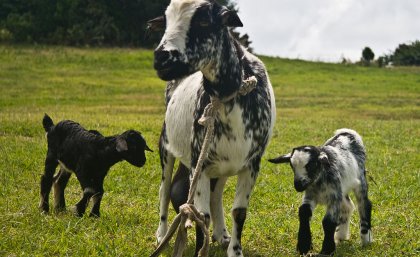
Q fever, an infectious disease which causes prolonged, debilitating illness, is transmitted to humans from goats, sheep, cattle and other animals.
UQ’s School of Veterinary Science and Child Health Research Centre’s Dr Ricardo Soares Magalhaes said that a larger proportion of recent human cases were not associated with livestock and there is some evidence environmental contamination and wildlife might be involved.
“One theory is that intensification of animal production, dust storms and severe weather might be affecting airborne transmission of the disease from farms to surrounding communities,” Dr Magalhaes said.
“Human Q fever cases have traditionally been associated with livestock enterprises, so we are not sure what is going on.”
UQ researchers will lead the investigation into the role of environmental contamination and airborne dispersion from farms.
“UQ will be involved in studying the role of environmental contamination and geographical mapping of airborne Q fever dissemination,” Dr Magalhaes said.
“We’ll use geographical information systems previously applied to mapping bird flu to track the transmission from farms and detect the bacterium Coxiella burnetii, which causes Q fever.
“We’ll look at whether goats play more of a role than other livestock or wildlife in the infection in Victoria and Queensland, and how infections in the air decay with distance, using air filters stationed at different distances.”
Federal Agriculture Minister Barnaby Joyce recently announced funding of $514,500 for the project in round two of the Rural R&D Profit Program.
The study has also attracted $1.1 million cash and in-kind partner contributions, including $120,000 support committed by UQ over three years.
Dr Magalhaes said the project aims to develop a better understanding of factors influencing the risk of Q fever spread within Australian ruminant livestock enterprises.
“This project will provide knowledge that can be used to develop policies that will limit the likelihood of a large and prolonged Q fever outbreak in Australia.
”This will help to maintain Australia’s position as an exporter of premium agricultural produce.”
The project: Taking the Q (query) out of Q fever: developing a better understanding of the drivers of Q fever spread in farmed ruminants also includes partner contributions from the University of Melbourne; Meredith Dairy; Australian Rickettsial Research Laboratory; University of Sydney; University of Adelaide; Charles Sturt University; Goat Veterinary Consultancies; Victorian Department of Economic Development, Jobs, Transport and Resources (DEDJTR), and QDAF.
Media: Ricardo Soares Magalhaes, r.magalhaes@uq.edu.au, +61 7 54601 827, or +61 424 950 431.


